

Human & Machine: Torque – when timelines lock up
A short reflection

Geoffrey Bowker and Susan Leigh Star1 introduced the concept of torque to describe something fundamental in the encounter between humans and systems: the twisting force that emerges when different timelines pull in different directions.
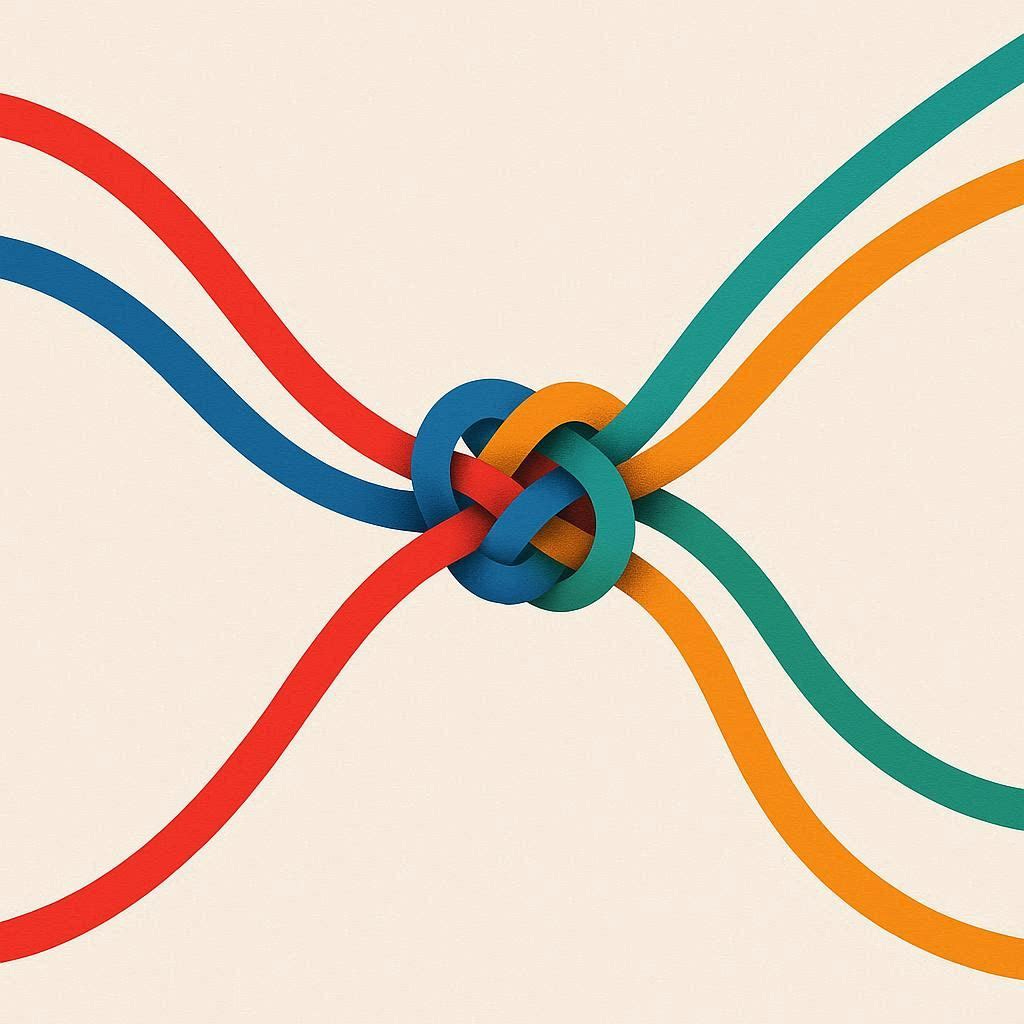
Imagine a ball of yarn where multiple threads run parallel. When they pull in the same direction, work flows frictionlessly. But when the threads begin pulling against each other, knots form – the system locks up and every movement worsens the situation.
Four threads that tear
In social services, four distinct timelines meet every day:
Political chronos – election cycles, budgets, the next vote as horizon
Research’s slow maturation – decades between problem and evidence
The child’s biological clock – critical periods that won’t wait for investigations
Crisis’s exploding now – where every day can be decisive
As social workers, we stand at the junction where these threads meet. When they’re synchronized, there’s no resistance. But when they begin pulling in different directions – when politics demands quick results while research says “wait,” when the child can’t wait but the system must investigate, when crisis requires immediate action but regulations require process – then torque emerges.
The nightmarish quality
Bowker and Star describe how this misalignment creates an almost nightmarish quality. It’s not just about stress or pressure – it’s the feeling that the system twists against itself.
And perhaps those already most vulnerable suffer worst. Families are expected not only to handle their difficulties but also to navigate this twisted system, negotiate with professionals whose hands are bound by different threads pulling in different directions.
Working in the knot
Our professional reality is to live in this torque. To feel how the threads pull – politics’ demands for efficiency, research’s warnings about hasty solutions, the child’s silent cry for action, crisis’s urgency.
Here, skill is required to navigate. And perhaps we should begin seeing this torque as a phenomenon. Stop pretending all threads can be perfectly synchronized. Build in flexibility precisely where knots most often form – where Human biographical time meets Machine’s systematic demands.
For when we understand that the problem isn’t that someone pulls wrong, but that the system constructively generates twist through its design, we can begin designing differently.
A reflection on Social Work
Bowker, G. C., & Star, S. L. (1999). Sorting Things Out: Classification and its Consequences. Cambridge, MA: MIT Press.